Fanciful collections — the list that calibrates the frame
August 11, 2026. Ethan, riffing off the idea that the coaxing conversation preserves material no sorted container can: “new collection type: ‘your most meaningful conversations’ hahahahaha. We need to make a list of highly fanciful collections like this just to obtain the right frame for collections.” And on why the list is the right instrument: “it’s impossible for us to design a container for every kind of collection, but it’s certainly within scope to design the right categories to cover what a collection could be in totality. Hah, the categories so hated by constello become necessary here.”
The categories in question are the eight of the coax conversation — expanded from six on August 11, 2026, when Ethan widened the definition to the umbrella (“a collection is anything that can be said to be the accumulation of your choices”) and ruled the categories must span it in totality, logged accumulations included: “we will never be able to make containers for everything people log, and the whole point is that they dont see these things as collections in the first place — they will surface through conversation as well.” The full discriminator: a person’s relation to any accumulation of their choices is exactly one of three kinds — they built it (curated: the board, the playlist, the shelf, the vault — deliberate assembly, the one category whose owner already knows it’s a collection, which is why a probe-born system missed it until Ethan caught the gap), they keep it, or it grew behind them. Made, kept, or unattended: no fourth option. Within kept, the six keeping-relations cover the object’s whole life: take-in covers acquisition (the reflex — collected before deciding to), refuse covers custody (kept against all reason), return and express cover use, inward and outward (the 1am revisit; kept things doing duty as language), tend covers upkeep (cost paid repeatedly), mourn covers loss (carried as absence). If the accumulation just grows behind them — the listening history, the searches that keep returning, and equally the machine’s own middens like the Downloads folder, choices recorded with no keeper — it’s the seventh, the trail, regardless of whether it lives on a platform’s servers or the person’s own disk. Related or unattended: no third option, so the span is total by construction, and a collection type nobody imagined is still reachable by category. (True residue shrinks to accumulations of circumstance rather than choice — the saved Wi-Fi list — which fall outside the umbrella entirely.) The seventh’s verb history: “reach” was retired the same day as imprecise — Ethan: “I think reach in an imprecise verb you only settled on because when these were first conceived, it nicely completed an alliteration triplet” — correct, and replaced with “express.” The roster grows only by field evidence — an origin conversation turning up a carried thing no category elicited — never by armchair enumeration, same epistemics as the anchor ladder.
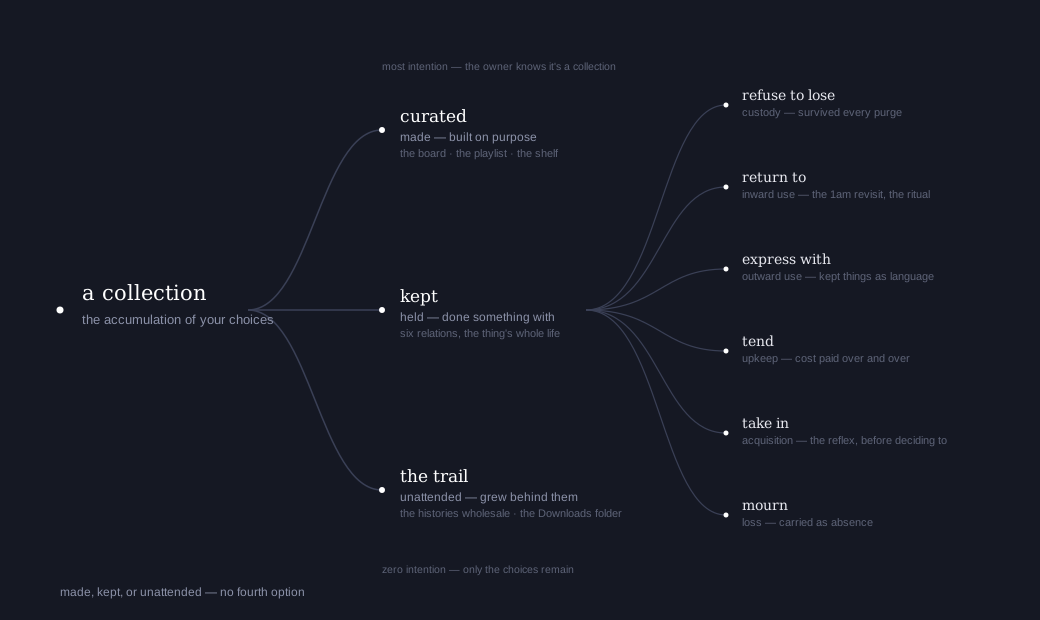
Why these categories don’t violate the founding objection to categories: they are input-side, not output-side — categories of questions, not of people. A category here is a search angle, used for one question and discarded; no person is ever “a mourner,” no collection filed under “tending.” Ethan: “this solidifies why they cant be labels: the person who mourns isnt characteristically different from the person who returns, they could very well be the same people in different circumstances. Not a useful categorization.” The lifecycle drags everyone through all the relations eventually — whatever you tend you will someday mourn — so partitioning people by category would partition by circumstance, like categorizing people by “currently holding a cup.” The description of the person happens exactly once, in the reading, custom-built; everything upstream is optics for gathering light.
The list itself, grouped by the category that finds each one. Every entry doubles as an interviewer question — and half of these would get a wave-off (“that’s not a collection, that’s just my phone”), which is the confirmation that the coax conversation is the only door most of them will ever come through. Nobody arrives at the mint saying “I collect unsent drafts.” But everyone has them.
Curated (built on purpose — the kind its owner would name):
- The Pinterest board; the playlist sequenced like an argument
- The shelf arranged just so; the vault
- The outfit assembled from things that individually meant nothing
Pure refusal (kept against all reason):
- Contacts they’ll never call and can’t delete
- The clothes that survived every closet purge without ever being worn
- Voicemails from people who are gone — kept, never replayed
- The abandoned hobby’s equipment, unsold through three moves
- Fortune-cookie fortunes living in a wallet’s crevices
Return (the 1am collection):
- Conversations they scroll back years to re-read — the seed of the list
- Songs they can’t listen to anymore — kept precisely because playing them costs too much
- The comfort media rewatched past all novelty — the same show, eleventh time
- Screenshots of compliments, revisited in bad weeks
- The note titled “ideas,” opened constantly, never added to
Express (kept things as language):
- Jokes retold so often their partner can perform them
- The meme folder maintained for one specific recipient
- Stories that have hardened into set pieces — same beats, every telling
- The song sent instead of the feeling
The trail (accumulating behind them, unattended — the records taken wholesale):
- The listening history; the watch history; the search history; the order history
- The Downloads folder as a dig site — what software they were interested in, era by era
- The apps installed and forgotten; the desktop’s sediment
(The habits inside a record can belong elsewhere — the one dish always ordered is a return-ritual; the record itself, as an object nobody tends, is the trail. Categories classify accumulations, not behaviors.)
Tending (cost paid repeatedly):
- The dead friend’s plant; the sourdough through two moves
- Streaks, digital pets, save files — worlds kept alive by daily visitation
- Group chats they single-handedly keep breathing
Return, continued (ritual):
- The usual — what they always order, everywhere; the route always walked for no reason
Intake reflex (collected before deciding to):
- Photographs of doors, or manhole covers, or skies from airplane windows
- Hotel pens and sugar packets — small thefts from places that mattered
- Words encountered and pocketed into a note
- Names hoarded for children, pets, and characters that may never exist
Mourning (carried as absence):
- Dead URLs still bookmarked — a library of 404s
- The hard drive that died in 2019, still brought up
- Usernames they used to be
- Last photos before haircuts
Frame-breakers (each one teaches something the groups above don’t):
- Unsent drafts: messages composed and never sent, kept anyway — a collection of withheld reaches
- Passwords over the years as an accidental diary of what mattered per era
- Technically terrible photos kept for who took them — where the metadata is the object
- Browser tabs open for eight months — intention itself, carried
- Places they’ve cried, if anyone kept the map
- Things they were wrong about, kept on purpose
What the list triangulates, frame-wise: a collection’s unit can be a conversation, an absence, a reflex, a draft, or a ritual — not just a thing. Its valence can be negative — kept because it hurts, kept because it’s unplayable. Its medium can be pure metadata. Bulk is not a disqualifier either: in an endless stream where every next thing could be novel, recurrence is election — the person who saves 40,000 images has still voted, because what keeps reappearing across that volume is choice made visible at the statistical level instead of the item level. Ethan: “what keeps appearing, time and time again, despite an endless stream of content that could just as easily be ever-novel?” A hoard doesn’t hide the signal; it’s the signal in a different notation, and contact sheets are the instrument that reads it.